Listening Before Language
A Conversation with Mohammad Nooran Khezeli | Interviewed by Aswathy Rajan,
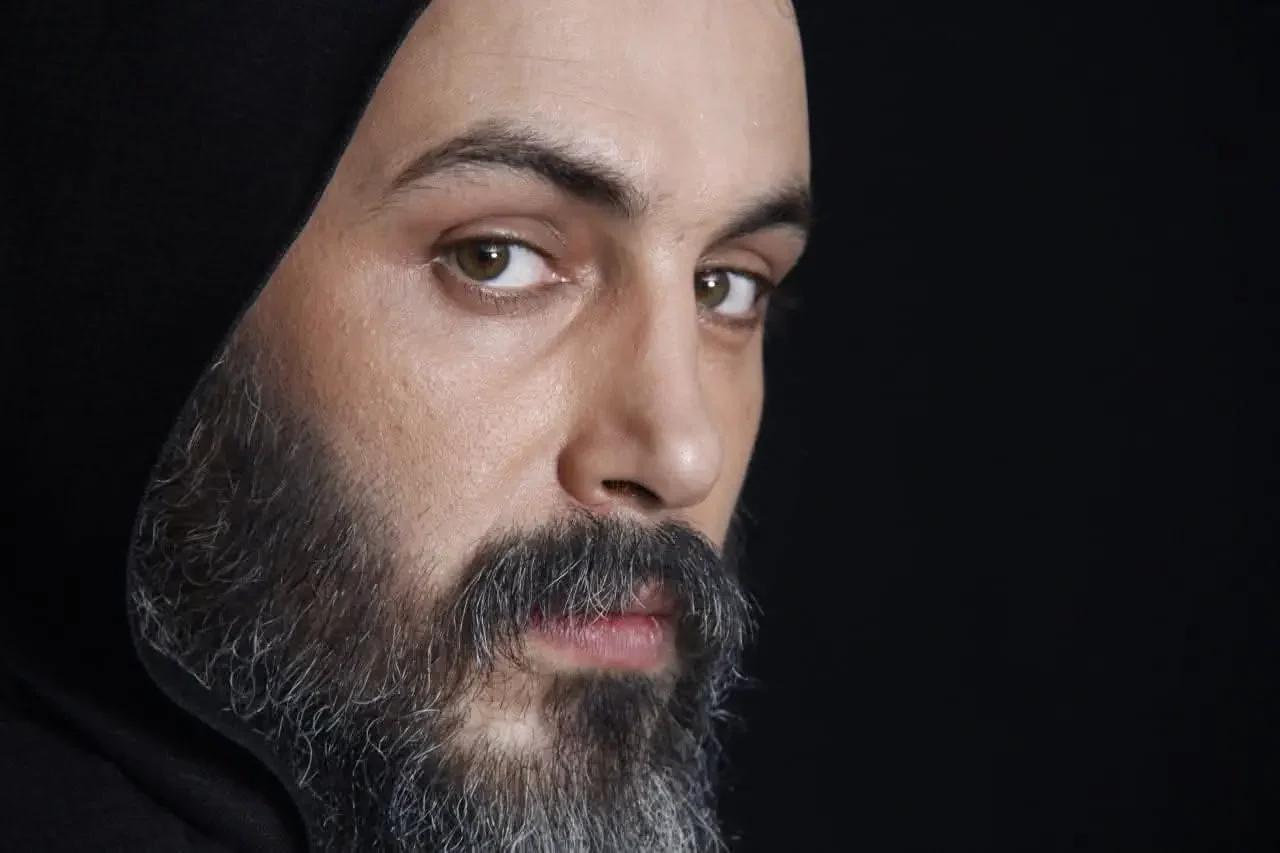
Theatre practitioner, musician, acting coach, and filmmaker Mohammad Nooran Khezeli has lived between Iran, India, and Türkiye, where each place has reshaped not only his artistic practice but his understanding of listening, memory, and performance. In this conversation with BETWEEN, he reflects on the body as a living archive, silence as a form of meaning, and the quiet ways art continues long after the performance has ended.
Before the Conversation
Before theatre became his language, football shaped his body. Before music became his practice, rhythm arrived through his mother’s lullabies and his father’s discipline. Mohammad Khezeli who chose the name Nooran, after his grandfather was born in Tehran, Iran, on 7 May 1984, into a family where perseverance was inherited long before it was named.
His father, born in a village near Nahavand, moved to Tehran as a child and pursued football with extraordinary dedication. Before the 1979 Iranian Revolution, he was invited to join Iran’s national youth teams, but history interrupted that journey. Family responsibilities eventually replaced a professional sporting career, though coaching remained part of his life. He became the first coach of both his sons.
Nooran followed that path with equal intensity, playing for clubs including Bank Melli, Shahin, and Esteghlal F.C. while representing Iran at youth, junior, and university levels. Then, in 2002, a devastating car accident claimed the lives of five people. He was the sole survivor. The accident ended one life before another had fully begun.
Yet another path had already been unfolding quietly. Music, theatre, and performance once a private passion became the centre of his life. He studied Acting at the University of Arak, completed a Master’s degree in Performing Arts at the University of Hyderabad, and later earned a PhD at Ege University in Türkiye, researching the impact of a role on an actor during performance and after it has ended.
Today, he lives in İzmir with his wife, Sanaz, an actor and movement designer and their two children, Ario and Artemis.
Is there a sound you still carry from before you became an artist?
I think one of the strongest of my five senses is my sense of hearing. I have always felt that listening and sound have had a very deep connection with my life and my identity.
Sometimes I wonder if that connection actually began before I was born, when my mother was carrying me. The lullabies she sang to me, and the sound of her heartbeat that surrounded me in the womb, may have been my first music. That rhythm had already begun to live inside me long before I started studying music or theatre professionally, and it has stayed with me ever since.
Because of the circumstances of my life, I was not directly involved with music and theatre during my early childhood. But art was always somewhere beside me. I began learning music as a child. I played the keyboard and later learned the guitar. From around the age of six, I also found myself on stage in different school settings, from primary school through middle school and high school, experiencing theatre in different forms.
At that time, football was a huge part of my life, and most of my time and energy went into it. But art was always there, quietly present in the background, almost as if it were waiting for the day it would become the main path of my life.
Today, I think I inherited the rhythm of life and music from my mother, and perseverance and discipline from my father. My father was my first coach not only in football, but in life. He taught me to keep going, to work hard, and not to give up.
My father passed away in 2019, but I still feel that, in some invisible way, from a distance, he is watching over me and guiding me.
When I think about that “sound,” I realise it is not one particular sound. It is a combination of my mother’s heartbeat, her lullabies, the rhythm of music, and my father’s voice. Those sounds existed within me long before I ever thought of myself as an artist, and they remain part of what draws me toward art, music, and theatre today.
When does a place become part of your artistic vocabulary?
One of the people who has had a profound influence on me since I was sixteen is Jalal al-Din Rumi, one of the greatest Persian-language poets. After my accident, I returned to his books and began reading them again. Throughout my life, Rumi has been someone I could turn to for guidance. In a way, he is like a spiritual guide for me. Whenever I need help or direction, I return to his words.
There is a line attributed to Rumi in which he speaks about belonging beyond fixed identities and places that he does not belong exclusively to one religion or one place, but wherever there is love, wherever he is able to live and experience love.
Not Christian or Jew or Muslim, not Hindu, Buddhist, Sufi, or Zen. Not any religion or cultural system. I am not from the East or the West…
This idea has been an important principle in my life.
It became even more meaningful when I moved to India. India made this idea of belonging much more visible to me. You encounter people living in different cities, speaking different languages, following different traditions, and coming from very different cultural backgrounds. Yet despite all these differences and all the difficulties that exist, people continue to live alongside one another. For me, that was a very powerful experience.
I began to understand that we do not have to belong to only one place. When you move somewhere new, you bring everything you have experienced with you, and then you begin to integrate those experiences with the new environment. At the same time, you begin learning from that place. When you learn to respect a new city, its people, its culture, and its way of life, the place also begins to give something back to you. That exchange can have a profound influence on the way you see life and, especially, on the way your artistic path develops.
For me, language is also a very important part of this process. When you learn a new language, you are not simply learning words and grammar; you are also entering a culture. I believe that before you can truly become comfortable with a language, you need to understand something about the culture that carries it. Naturally, when you live in a different place and learn about its culture, you begin to carry traces of that culture into your artistic work.
I see this as one of the distinctive qualities of my own journey. I cannot claim that my work is always successful, but I am genuinely grateful to have had the opportunity, especially in India to encounter cultures that were very different from the one I grew up with. Those experiences have had a deep influence on me. Now that I live in Türkiye, I continue to experience the same process.
To me, this is what a place eventually becomes: it stops being simply a location and becomes part of your vocabulary your artistic vocabulary, but also your vocabulary as a human being.
Learning from a new environment and adapting to a different culture can certainly be difficult, especially when we are far away from our homeland. But if we are able to adapt without losing ourselves, the result can be something very meaningful. We begin to carry different places within us, and those places become part of the way we see, think, create, and tell stories.
Has modern life changed our ability to listen?
I think modernity has had both positive and very negative effects on us. One of the negative effects, for me, is the way it has polluted our sense of hearing. We are constantly surrounded by unnatural sounds produced by cars, motorcycles, factories, machines, and all kinds of technological devices. We have gradually become accustomed to living inside noise.
I also believe this has affected music itself. If you listen to music from the 1970s and even the 1980s, and compare it with much of the music being produced today, regardless of the country, you can feel a significant difference. It is not only that melodies seem to have become weaker; the lyrics have also changed, and even instrumental music, including film scores, has been affected.
What concerns me most, however, is rhythm.
I feel that modern life has disrupted our relationship with rhythm. Rhythm is not simply something we hear; it is part of the way we live. It is connected, at least in my understanding, to our psychological state, our breathing, our heartbeat, and the rhythm of everyday life. When the rhythms surrounding us become increasingly chaotic, I feel that something inside us also becomes less balanced.
This is my personal observation rather than a scientific claim. But I strongly believe that the changes in rhythm, tempo, and melody taking place around us are affecting the way we experience the world.
There was a time when, even in the middle of a city, you could hear birds. You could hear the rain. You could hear the wind. Today, much of that soundscape has been replaced by technological and mechanical noise, the constant movement of traffic, machines, factories, electronic devices, and the countless signals and notifications that surround us.
We have reached a point where, instead of listening to the sound of rain, we may find ourselves waiting for the sound of a message arriving on our phones.
For me, that is a very sad transformation.
The greatest danger is that we are slowly forgetting how to listen. We are losing our relationship with silence, with natural sounds, and with the subtle rhythms that once existed around us.
When we lose the ability to listen, I wonder whether we also begin to lose something in the way we feel, imagine, and create.
That is why, for me, sound and rhythm are not merely artistic elements. They are part of the way we exist. I feel that modern life is changing that relationship every day, and unfortunately, I think it is getting worse.
What responsibility comes with transforming life into art?
I believe everything we experience and live through is already a kind of performance. As Shakespeare says, life itself is a stage, and we encounter different performances and different roles every day.
This idea is very close to my own research as well. One of the things I discussed in my PhD thesis is that we perform much more in our personal lives than we do as actors on a stage or in front of a camera. We are constantly playing roles, consciously or unconsciously, within our relationships, our families, our societies, and our everyday lives.
When an experience is transformed into a play, a screenplay, a work of art, or even a song, it inevitably goes through a process of transformation. The moment an artist begins to write or create, the experience is no longer exactly what happened in reality. It passes through the artist’s perspective, imagination, language, and medium.
That is why, when it comes to someone’s story or the life of an important figure, I believe an artist should have the freedom to create but that freedom must come with respect.
If, one day, we decide to make a film or a play about an important historical or cultural figure, I believe it can be done, provided there is serious research and genuine respect for the person and the story. At the same time, we have to accept that the moment we turn reality into art, we are interpreting it.
Art is a medium, and every medium carries its own ideology. Whatever we create, there will always be people who connect with it and find it meaningful, and others who disagree with it or even reject it. That is part of the nature of art and media. Whether it is a television network, a piece of music, a painting, a film, or a play, the medium itself influences the way the story is presented and understood.
Even a painting can generate countless interpretations. We can look at a painting by Raphael, for example, and find different readings of its relationship to Aristotle, Plato, philosophy, religion, and knowledge. The same thing happens with theatre.
I do not believe we should avoid telling someone else’s story. I believe we can create our own work from a real story, as long as we approach it with respect, responsibility, and research. Ultimately, the trace of the writer, the director, or the artist will always remain in the work. The original story may be the starting point, but the finished artwork inevitably becomes something new.
At the same time, I believe there are experiences that cannot truly be contained within words. There are things that language simply cannot carry or communicate completely.
When language reaches its limits, music can sometimes do what words cannot. That is one of the reasons music has such a powerful place in my understanding of art. It can communicate something that cannot always be explained through language not necessarily by telling us what something means, but by allowing us to feel it.
Can listening itself become a creative act?
There has been a great deal of research and discussion about listening. There are even many books with titles such as The Art of Listening. I believe that the ability to listen can be cultivated, although it is not always easy, and that cultivation can begin in childhood.
For a child, being introduced to music and the sounds of nature from an early age can be a profound experience. It is a kind of education of the ear. As we cultivate our ability to listen, we gradually develop a deeper understanding of music and sound.
If someone asks you to listen to a piece of classical music, but you have never developed the ability or the patience to listen to it, you may understand very little of what you are hearing. In that sense, listening to music can be similar to reading. What is easier for someone who has never studied philosophy: reading a novel or reading a philosophical book? A novel is usually more accessible because our minds are more immediately prepared to receive and understand a story. A philosophical text requires a different kind of preparation.
Listening itself requires cultivation.
That cultivation may be most effective when it begins in childhood, but I do not think it is ever too late. At any age, we can continue to educate not only our ears, but also our eyes and our other senses.
By seeing good things, reading good books, listening to good music, watching good films, and exposing ourselves to meaningful forms of art, we gradually strengthen our ability to perceive and understand.
For me, listening is not simply preparation for a creative act. Listening itself is already a creative act, because when we truly listen, we are not simply receiving something. We are interpreting it, feeling it, connecting it to our own experiences, and creating an understanding of it within ourselves.
That is why I believe that before we can become good creators, we first need to learn how to become good listeners.
What allows art to cross another person’s inner world?
I believe that regardless of what language we perform music in, what style of music we choose, what our musical background is, how professionally we play an instrument, how technically skilled we are as musicians, or how professionally we sing, there is something more important than all of these things.
That is honesty.
In fact, I do not think this applies only to music. I believe honesty is one of the most important elements in every form of art.
It does not matter where we perform, who we perform for, who the audience is, or what language we use. Even if the audience does not understand our language, even if they have no previous experience with the kind of music we are making, or are unfamiliar with the artistic form we are presenting, sincerity within the work can still reach them.
For me, honesty has the power to cross boundaries that technique, language, culture, and even artistic style sometimes cannot.
A truly honest work can communicate something directly to an audience not necessarily because they understand every word or recognize every musical element, but because they can feel that the artist is being genuine.
That, for me, is what makes an artistic work powerful: not simply how technically perfect it is, but how truthfully the artist is able to stand behind it.
Ultimately, I believe an audience may forget the language, the technique, or even the details of a performance, but they will remember how honestly the work made them feel.
Beyond honesty, especially in music, I think there is another element that can cross borders: the pain experienced by the person who created the work.
If, for example, you are making a film about poverty, you cannot approach that subject only through slogans or from a distance. For the audience to truly receive that feeling, you either need to have experienced that pain yourself, lived close to it, or developed a genuine empathy for those who have.
Otherwise, honesty becomes the question. The audience can somehow sense whether the pain within a work has been genuinely experienced or whether it is simply being represented from the outside.
When I speak about pain, I do not necessarily mean a pain that destroys or consumes you. I think pain can also become a source of transformation. It can be the kind of pain that makes you, like a phoenix, burn completely and then rise again from the ashes.
That, for me, is what truly travels across borders not simply the melody or the language, but the emotional truth behind the work: the experience, the pain, the vulnerability, and the transformation the artist has genuinely lived through.
What does it mean to enter a stage after learning how fragile life can be?
Ever since the accident I experienced, I have carried one thought with me before every performance: this could be my last scene; this could be the last song I sing; this could be the last theatre performance I ever take part in.
That thought changed the way I enter a stage. I have always tried to communicate something I genuinely feel to transfer my own emotions and experiences to others through the work. Because of what happened, I try to give everything I have to each performance, both emotionally and physically. I believe that when an artist truly gives themselves to the work in that way, the feeling reaches the audience.
There is also something I constantly remind my actors of, particularly when we are working on emotional scenes. I tell them: Do not chase the emotion first. First, act. First, perform the action. The emotion will come later.
For me, emotion should not be something an actor desperately tries to produce. If the actor genuinely commits to the action, repeats it through rehearsal, understands the circumstances, and remains present within the scene, the emotion eventually follows almost automatically.
In other words: first act, then emotion comes later.
This idea is closely connected to my understanding of silence.
Jean-Louis Barrault, one of the great figures of twentieth-century mime and theatre in France, described theatre as “interrupted silence” , a continuous silence broken by dialogue and speech.
I find this idea extremely powerful. I see theatre as silence that is periodically interrupted by words. The dialogue does not create the silence; rather, it breaks it.
The same principle exists in music. If we speak continuously, or if we play a piece of music without allowing any space to breathe, its impact becomes weaker. Silence gives sound meaning. The moments in which nothing is said or played can sometimes communicate as much as, or even more than, the words and sounds themselves.
In my community practice with music, I am not trying to recognise myself inside someone else’s silence. Instead, I try to create a space where people can listen, feel, act, and eventually allow their own emotions to emerge. Sometimes silence is already communicating something before either of us has found the words for it.
Can audiences discover meanings the artist never intended?
Absolutely. I think this happens all the time, and I believe it is one of the beautiful things about art.
There is a concept in hermeneutics that reminds us that every person approaches an artistic work from their own perspective and interprets it through their own experiences, memories, and understanding of the world.
This has certainly happened to me. There have been times when I created a work of art, or performed a piece of music, with a particular feeling or intention in mind, and later discovered that an audience member had received it in a completely different way.
Sometimes, when I listened to their interpretation and reflected on it, I realized that their understanding was also genuinely valuable. It may not have been the meaning I originally intended, but that does not necessarily make it wrong.
This is also connected to reception theory. In the humanities, we are dealing with something fundamentally complex: the human being. Every person looks at life from their own position, history, and perspective.
For that reason, I do not believe there is always one absolutely correct interpretation of an artistic work, just as I do not believe every different interpretation is necessarily wrong.
Once an artwork leaves the artist and reaches the audience, it enters another world, the world of the audience member. They bring their own memories, experiences, emotions, and perspective into the work.
I think the most beautiful misunderstanding is the one that reveals something about the audience that even the artist had not seen before.
That is one of the reasons I value the audience so much. An artwork is not always finished when the artist completes it. In many ways, it continues to live and change through the people who experience it.
Where does theatre continue after the performance ends?
When an artistic work ends, I believe it must leave something behind. If someone watches a film, sees a theatre performance, or listens to a piece of music and walks away without carrying something with them without receiving something, feeling something, thinking about something, or being affected in some way then, for me, it is difficult to call that a true work of art.
That is why so many pieces of music and so many films produced today are forgotten after a certain period of time. Yet there are works that continue to live far beyond the moment in which they were created.
People are still talking about Toshiro Mifune, the great Japanese actor, and about the influence he had on other major actors, including Clint Eastwood. Why? Because real art is not limited by time or place.
Its impact can become so profound that, over time, it becomes part of a culture. It enters the collective memory and becomes part of the way people understand and experience the world.
I think this can even happen with commercial cinema. If we look at the history of Hollywood and American popular culture, we can see this very clearly with Rocky. When Sylvester Stallone first made Rocky in the 1970s, he was initially seen by many as an outsider, even as a failure. Today, the musical theme of Rocky, as well as the films themselves, has become part of the culture of competition and perseverance not only in the United States, but in many parts of the world.
For me, this is where art continues to exist after the performance has ended. It continues in memory, in conversation, in culture, and in the way people carry its images, sounds, and ideas into their lives.
A true artistic work must eventually leave the boundaries of the theatre, the cinema, the concert hall, or whatever cultural space it was created in. If it continues to affect people after they leave that space, then the work is still alive.
I think that is one of the most important qualities of art: it can outlive its own time and place.
How do your different artistic identities shape one another?
I think acting, directing, teaching, and music have all shaped my identity in different ways.
But I do not see identity as something fixed or permanent. Just as I am constantly changing as a person, my identity changes every day. The actor in me has one identity, the director in me has another, the teacher in me has another, and the musician in me has another. All of these are different pieces of the same puzzle.
If you ask me which one changes me the most, I would not necessarily choose one of these roles. I think it is my way of thinking and my perspective on life that continuously shape all of these identities.
My way of thinking influences the actor I become, the director I become, the teacher I become, and the musician I become. At the same time, all of these experiences come together to shape what I consider my overall identity.
I do not really surrender to one particular role. Instead, I allow each role to become part of me, while my understanding of life continues to change and reshape all of them.
In that sense, I do not think there is a single fixed “me” behind the actor, director, teacher, and musician. There are different parts of me constantly communicating with and influencing one another.
What has teaching made you reconsider about art?
Absolutely. In fact, this is one of my strongest beliefs about teaching.
I believe that anyone who genuinely teaches, and who truly has a passion for teaching, eventually realizes that the learning process does not move in only one direction. It is not simply that the student learns from the teacher.
Very often, while teaching, the teacher is the one who experiences, discovers, and learns even more.
Every time I teach a subject, I encounter something new within it. Even if I have taught the same material before, teaching it to a different student or a different group can reveal something I had not noticed previously.
Students bring their own questions, experiences, ways of thinking, and ways of seeing the world. Those things can force a teacher to look again at something they thought they already understood.
Teaching has certainly taken me to places where I have had to reconsider things I once believed about art. I think this is one of the most valuable aspects of teaching: it prevents us from believing that we have already understood everything.
For me, a good teacher is also a continuous learner. Every time I teach, I discover something new. In that sense, teaching is not simply the act of giving knowledge to someone else; it is also a process of rediscovering the subject and sometimes rediscovering yourself.
Can the body become an archive?
I think people who live in Asia, and particularly people in a country like India, may understand this question more deeply than someone from a different cultural background. There are particular ways of walking, standing, moving, performing, and even using the body that become part of a culture and are passed from one generation to another.
I strongly believe that traditional performing arts, stories, legends, and narratives rooted in a culture have played an important role in preserving that culture until today. Things that were experienced and lived by our ancestors many generations ago can still exist in the present because they have been carried through performance and through the body.
I think this is especially visible in India. Traditional and performing arts have helped preserve cultural practices to such an extent that we can still see traces of these forms not only on the stage, but also in everyday traditions and social practices.
In some ways, I think you, as an Indian, may be able to answer this question even better than I can. But I strongly believe that the body can become an archive. Sometimes culture survives not because it has been written down, but because someone continues to remember it through their body and continues to perform it.
For me, rhythm is deeply connected to the way we remember, experience, and communicate. It is another way in which the body carries memory across generations.
Can silence communicate more than language?
Absolutely. I believe there are many moments when a gesture, a movement, a look, a nod of the head, a piece of music, or even a completely silent shot in a film can communicate much more than spoken language.
Sometimes words simply do not have the ability to express something fully. Let me tell you a story from Iranian history that illustrates this idea very well.
There was a king of Iran named Khosrow Parviz, who had a horse called Shabdiz. He loved this horse enormously, even more than many of the people close to him. He was so emotionally attached to the horse that those around him were afraid of telling him if anything happened to it.
At the court of Khosrow Parviz, there was also a famous musician and composer named Barbad, who was very important to the king.
One day, Shabdiz died. The people at the court knew that someone had to tell the king, but nobody had the courage to deliver the news because they knew how deeply he loved the horse. Eventually, they asked Barbad to do it.
Instead of telling Khosrow Parviz directly, Barbad decided to play a piece of music. This piece later became associated with the name Shabdiz.
The music was instrumental, without words, but it had such a powerful emotional effect on the king that, at a certain moment, Barbad stopped playing and allowed a moment of silence to remain.
In that silence, Khosrow Parviz himself understood what had happened and said, in effect, that Shabdiz, his beloved horse, had died. Barbad then continued playing.
Whether we look at this story historically or as a cultural legend, what interests me is the idea behind it: sometimes we do not need words to communicate something profound.
A piece of music can say it. A gesture can say it. A movement can say it. A simple nod of the head can say it. Even a single silent shot in a film can sometimes communicate more than an entire conversation.
That is one of the reasons I believe so strongly in the power of theatre, music, and the performing arts. The body, sound, silence, and movement can carry histories, emotions, and meanings that language alone is sometimes unable to contain.
Where does artistic responsibility meet human dignity?
This connects closely to what I said earlier about honesty in an artist’s work, and about the experiences and pain that lie behind an artistic creation.
If an artist brings genuine experience, honesty, and emotional truth into their work, I believe that once the work has been presented, the responsibility does not simply disappear. To a certain extent, the way the work is received also becomes the responsibility of the listener or the audience.
As artists, we have a responsibility to be honest about what we are presenting. We should not manipulate an experience or pretend to feel something we have never genuinely experienced. But once the work reaches the audience, each person receives it through their own history, emotions, experiences, and understanding.
We cannot completely control what another person will understand from our work, and I do not think we should try to.
For me, there is a difference between the responsibility of speaking and the responsibility of being heard. When I speak, I am responsible for what I say and for the honesty with which I say it. Once I have expressed it through my art, however, the audience also becomes part of the process. What they understand, feel, or take from it belongs to their own encounter with the work.
I think the most important responsibility of an artist is not to control the audience, but to be truthful in the moment of creation.
At the same time, reality can sometimes become stronger than the idea we originally had in mind.
For me, dignity begins with respect. When we create with or about another person’s life, we should never treat their experience simply as material for our art.
There is a difference between representing someone’s pain and exploiting it. An artist needs to understand that difference.
We have to listen, observe, and try to understand the person and their circumstances before turning their experience into artistic expression. Sometimes we may have to change our original artistic intention because the dignity and reality of the person are more important than what we initially wanted to create.
For me, dignity in art means allowing people to remain human not reducing them to their suffering, their poverty, their trauma, their identity, or their story.
The person must always remain greater than the artwork we are making about them.
What remains untranslated within you?
I think there is one part of myself that, despite all the years I have spent moving between different cultures, languages, and countries, has never been completely translatable: my love for my homeland, Iran.
I say this with complete respect for all nations, cultures, and peoples. I also believe we should move beyond blind nationalism and the idea that we must belong exclusively to one place. We live in an increasingly interconnected world, and I have learned enormously from every culture I have encountered.
But there is something about the land where you were born, the history that shaped you, and the culture that lives inside you that cannot simply be translated into another language or transferred completely into another culture.
When I speak about Iran, I am not speaking about the political regime that governs the country today. I am speaking about Iran as a historical and cultural civilization, a land with thousands of years of history, literature, poetry, philosophy, music, and cultural influence.
This connection is also something I have felt very strongly in India. Iran and India have had centuries of cultural exchange and influence on one another. We can see this especially through the Persian language and literature. Amir Khusrow was a great Indian poet who wrote extensively in Persian and had a profound love for the language.
Even in simple, everyday things, we can still see traces of this cultural exchange. In India, we encounter references to “Iranian tea” or “Iranian biryani,” while in Iran we commonly speak of Indian rice or Indian tea. Whether every one of these references is historically precise is not the main point for me. What matters is that cultures leave traces of one another in everyday life.
So, when I return to your question, I think what remains untranslated within me is this deep love for the land and history of Iran. It is something I carry with me wherever I live.
Music can sometimes communicate a small part of it. Poetry can come close. Art can give it a form. But there is a depth to that feeling that I do not think language can fully express.
For me, it is a love that is almost as fundamental as the love I have for my mother and father. It is not simply an idea of nationality. It is a connection to the soil, the history, the memory, and the culture that made me who I am.
I can live in different places, learn different languages, work with different cultures, and feel deeply connected to them. But this particular love for Iran, the Iran of its history, culture, literature, and people is something I do not think I will ever be able to completely translate.
One of the reasons I love India so much is that I recognize the same feeling in many Indian people. I see in them the same kind of deep connection to their homeland that I feel toward Iran.
I lived in India for four years, and whenever I have the opportunity, I return. I have made so many Indian friends and developed such a strong connection with this country. Part of that connection comes from this shared feeling, the love and emotional bond that many people here have with their own land, history, and culture.
So although I come from Iran and carry Iran very deeply within me, I do not feel that this love separates me from other cultures. In fact, it is one of the reasons I feel so close to India. When you recognize the same kind of love for one’s homeland in another person, you recognize something of yourself in them.