Gireesh Gopinathan on Panoramas BUT Not Quite
Interviewed by Nijil K, Assistant Professor, CFCS, University of Hyderabad
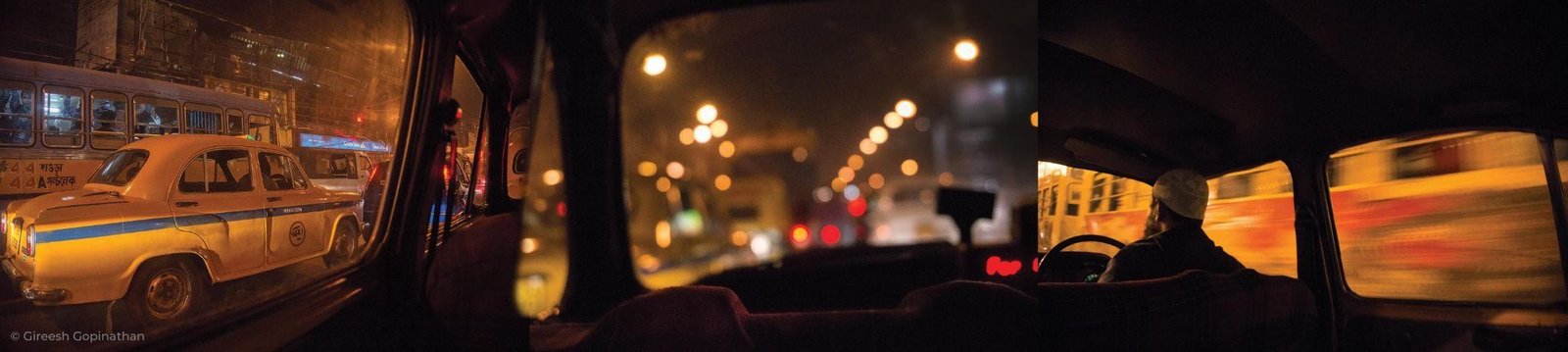
Yellow Taxi, from Panoramas BUT Not Quite. © Gireesh Gopinathan.
In Panoramas BUT Not Quite, photographer and visual artist Gireesh Gopinathan rethinks the panoramic image, not as a seamless, all-encompassing view, but as a fragmented and contemplative way of seeing. Rooted in years of observation and shaped by memory, perception and absence, the exhibition reflects a quieter, more philosophical engagement with landscape and vision. Presented at his alma mater, the College of Fine Arts, the show marks both a homecoming and an ongoing inquiry into how photographs can move beyond description into poetic and reflective space. We spoke to Gireesh about the evolution of the project, his process, and the questions of seeing that continue to guide his practice.
The title itself feels like a contradiction. What is the idea behind Panoramas BUT Not Quite?
The idea came from questioning the panoramic format itself. A panorama traditionally suggests a complete, sweeping view, but I was more interested in what lies beyond its edges, what escapes our gaze and how memory or imagination fills those gaps. These works invite viewers to experience landscapes as fragments, continuities and interruptions rather than perfect wholes.
Why call it BUT Not Quite?
The title is deliberately open-ended. It suggests something incomplete, a panorama that never quite resolves into totality. That feels closer to how we actually experience the world: through glimpses that are stitched together by memory and perception rather than through complete certainty.
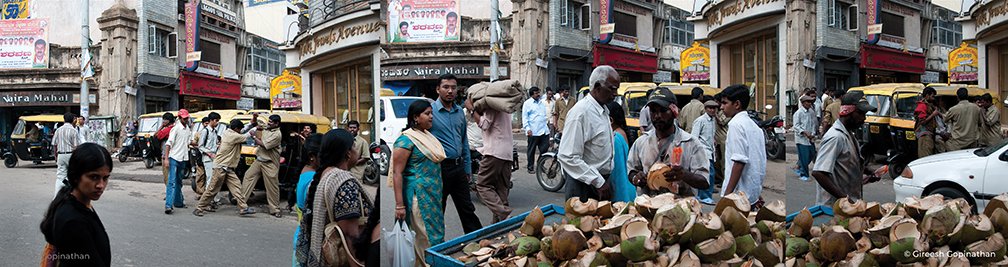
Venues on the Street. © Gireesh Gopinathan.
This project has been with you for quite some time. How did it evolve?
The earliest images in this series were made more than a decade ago. At the time, I didn't think of them as belonging to a single project. But over the years I kept returning to these unconventional compositions that resisted the panoramic "grand view." Gradually they began to speak to one another, and eventually Panoramas BUT Not Quite emerged as a coherent body of work.
How does this exhibition sit within your larger photographic practice?
Much of my work revolves around perception, identity and space, whether through documentary projects, abstract explorations or long-term studies. This exhibition extends those concerns into the landscape, asking how we construct places in our minds as much as with our eyes. It continues my interest in blurring the line between what is seen and what is remembered.
Showing this work at the College of Fine Arts must carry a different kind of meaning.
It is deeply personal. This is where my artistic journey began, where mentors and peers shaped the way I learned to see. Bringing this work back to the College feels like completing a circle while also opening a new dialogue with younger artists and audiences.
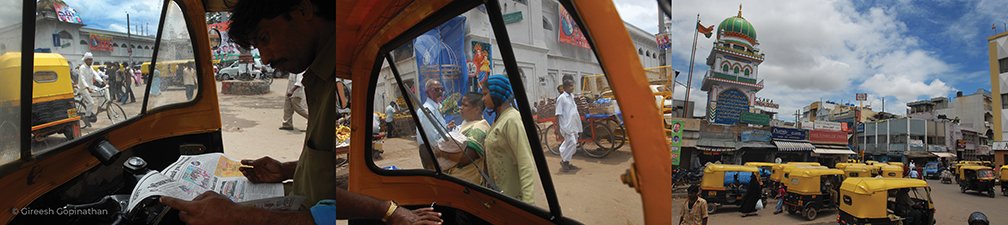
Today's Headlines. © Gireesh Gopinathan.
Could you tell us about your process?
I work with both digital and film cameras, but framing matters more than the equipment. I deliberately leave something out, allowing gaps and continuities to remain within the image. In post-processing, I avoid excessive manipulation because I want to preserve that sense of incompleteness. That's where imagination enters.
What do you hope viewers carry with them after seeing the exhibition?
I hope they pause and reflect on how we see. Landscapes and life itself are never complete or fixed. What we experience is always "not quite": something stitched together from fragments, memory, silence and imagination.
You've spent years making documentary work and publishing books. Where does this project stand among those long-term works?
Most of my earlier projects grew out of long-term documentation, communities, migration, faith, social realities and everyday life. They are grounded in sustained observation and engagement with the world around me.This project isn't fundamentally different in the way I approach my subject. What's different is the way I work with the photographs themselves. It's more inward-looking and philosophical. Rather than simply presenting a subject, I use fragments, overlaps and photomontage to question the act of seeing itself: what we see, what we miss and how we construct reality through images.The panorama montages appear to promise a complete view, but BUT Not Quite challenges that promise. No matter how wide we look, we never truly see the whole picture. By reconstructing images through photomontage, I'm exploring the space between what the camera records and what the mind perceives. In that sense, the project is less about what I see and more about how I see.
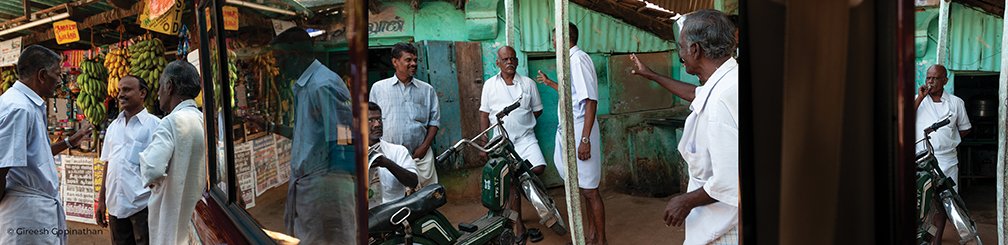
Puffs-Politics. © Gireesh Gopinathan.
What's next after this exhibition?
I'm working on several book projects, including long-term essays on communities, abstract conceptual work and explorations of night photography. Although they differ in subject, they all continue asking similar questions about perception, memory and how photography can move beyond documentation into poetic space.
Finally, what would you say to young artists and photographers?
Trust your curiosity. Don't chase trends or formulas. Let your practice grow alongside your life and your experiences. Some projects take years, sometimes decades, to reveal their true meaning. Technique matters, but patience, persistence and honesty matter just as much.
Most importantly, keep your eyes open. Look beyond what is immediately visible. Observe what's happening around you, question it and develop your own way of seeing.
I believe every photographer has the possibility of cultivating a "third eye", the ability to see beyond the obvious, to notice what others overlook and to recognise the stories unfolding in ordinary moments. Develop that third eye, and you'll begin to find what you're truly looking for.
About the Author: Nijil V. is Assistant Professor at the Centre for Folk Culture Studies, University of Hyderabad, where his work engages with folklore, visual culture, orality, and contemporary cultural practices. He is actively involved in research, teaching, and curating conversations around indigenous knowledge and cultural traditions.